Life on Land

11 Items

mceclip2-67e9e762bbfa1741fa81fe02771a8a2a.png

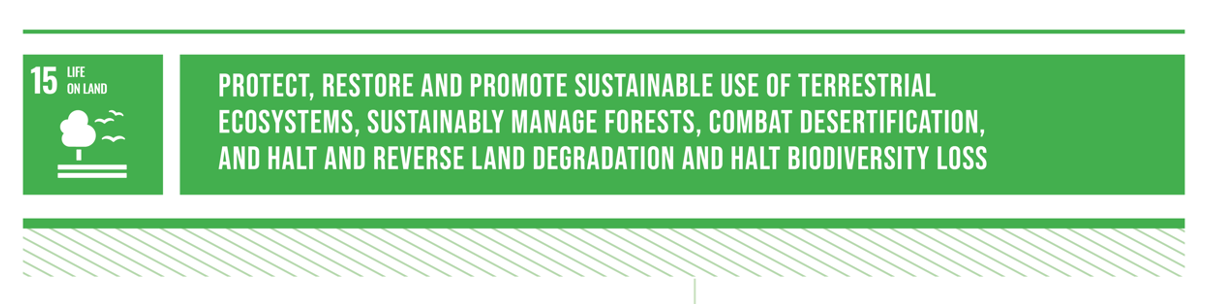
Protect, restore and promote sustainable use of terrestrial ecosystems, sustainably manage forests, combat desertification, and halt and reverse land degradation and halt biodiversity loss

Human life depends on the earth as much as the ocean for our sustenance and livelihoods. Plant life provides 80 percent of the human diet, and we rely on agriculture as an important economic resources. Forests cover 30 percent of the Earth’s surface, provide vital habitats for millions of species, and important sources for clean air and water, as well as being crucial for combating climate change.

Every year, 13 million hectares of forests are lost, while the persistent degradation of drylands has led to the desertification of 3.6 billion hectares, disproportionately affecting poor communities.

While 15 percent of land is protected, biodiversity is still at risk. Nearly 7,000 species of animals and plants have been illegally traded. Wildlife trafficking not only erodes biodiversity, but creates insecurity, fuels conflict, and feeds corruption.

Urgent action must be taken to reduce the loss of natural habitats and biodiversity which are part of our common heritage and support global food and water security, climate change mitigation and adaptation, and peace and security.

All Items

  • Albania-Basilicata: Migratory Dynamics in Development

    Ornella Albolino, Lucia Cappiello
    95-107
    DOI: https://doi.org/10.36253/bsgi-7600
  • Digitisation and Geographical Technologies for Sustainability: A Comparative Analysis of “Other Effective Area-Based Conservation Measures” Advancements in Mexico and Italy

    Alfonso Giordano
    105-121
    DOI: https://doi.org/10.36253/bsgi-7613
  • From Water to Desert: Evolution of Transportation Systems in The Aral Sea Area

    Giuliano Luongo
    91-96
    DOI: https://doi.org/10.36253/bsgi-7513
  • Marriage Seasonality in Italy in the Early 19th Century

    Alessio Fornasin, Marco Breschi, Matteo Manfredini, Gabriele Ruiu
    87-107
    DOI: https://doi.org/10.36253/bsgi-7576
  • Mountains as a “Fragile Territory”: What Sustainability for the Areas Affected by the Milan-Cortina 2026 Olympic Games? The Case Study of Cortina d’Ampezzo

    Monica Morazzoni, Valeria Pecorelli
    33-49
    DOI: https://doi.org/10.36253/bsgi-1732
  • Note sulla geografia umana del bacino dell’Ordos, Mongolia Interna, Cina

    Francesco Cosentino
    DOI: https://doi.org/10.36253/bsgi-7632
  • Regression and Risk of Extinction for Small Ethnolinguistic Minorities In the Alps-Adriatic Region. The Case of the German-Speaking and Istro-Romanian Islands

    Igor Jelen, Erika Džajić Uršič, Peter Čede, Ernst Steinicke
    17-32
    DOI: https://doi.org/10.36253/bsgi-7578
  • Retail Trade Restructuring Paths on the Fringes of a Strong Region: the Case of Lower Lombardy, Italy (2001-2019)

    Maria Antonietta Clerici
    127-146
    DOI: https://doi.org/10.36253/bsgi-991
  • Slow Mobilities and Heritage Landscapes

    Margherita Cisani, Maarja Kaaristo, Monica Meini, Dario Bertocchi
    3-6
    DOI: https://doi.org/10.36253/bsgi-7645
  • Slow Mobilities as a Medium for Re-Semantise the Landscape Heritage: The Case of The Aqueduct Cycle Route in Puglia

    Mariateresa Gattullo
    23-40
    DOI: https://doi.org/10.36253/bsgi-7480
  • Uncomfortable Walking: An Autoethnographic, Embodied and Mobile Investigation of the Encounter with the More-Than-Human

    Cecilia Pasini
    117-129
    DOI: https://doi.org/10.36253/bsgi-7496